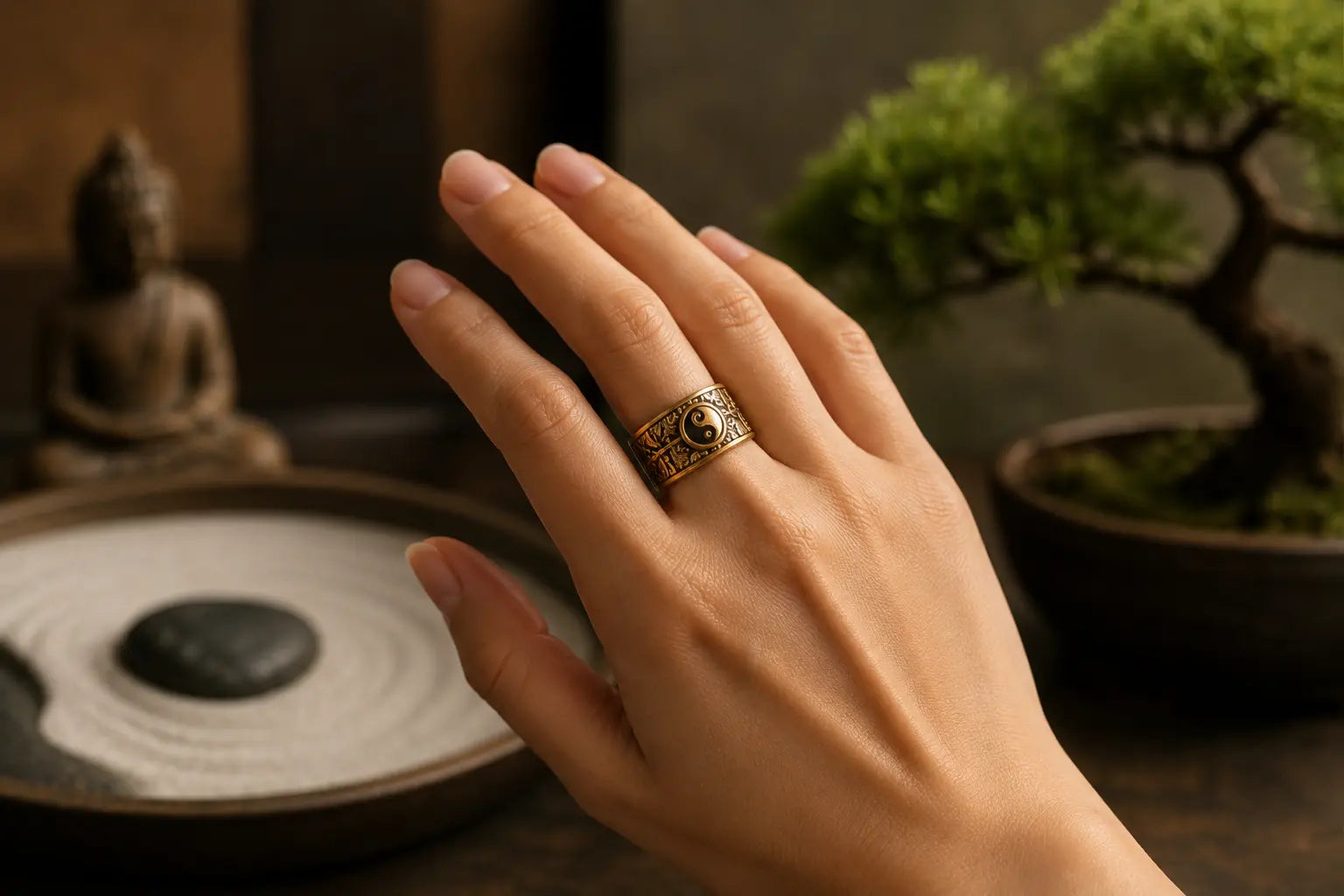
Which Finger Should You Wear a Feng Shui Ring On?
The best finger for a Feng Shui ring depends on the intention you want the ring to carry. The index finger can support direction, the middle finger can support balance, the ring finger can support devotion, the little finger can support communication, and the thumb can support willpower. The left hand usually feels more receptive, while the right hand feels more expressive and action-oriented.
That means there is no single correct finger for every ring or every person. A meaningful ring works best when the finger meaning, hand meaning, ring symbol, material, size, and daily comfort all support the same message. If a placement looks right in theory but feels awkward all day, the meaning becomes weaker because you will not wear the ring consistently.
This guide explains which finger to wear a Feng Shui ring on, how left and right hand meanings differ, what each finger can represent, which finger to choose for wealth intention, how ring material changes the meaning, and why comfort should be treated as part of the practice rather than an afterthought.
Which Finger Should You Wear a Feng Shui Ring On?
Choose the finger by intention first. If the ring is meant to remind you of direction, leadership, or a new path, the index finger is usually the clearest choice. If the ring is meant to support balance, responsibility, or steadiness, the middle finger often makes more sense. If the ring carries devotion, relationship, renewal, or a personal promise, the ring finger can feel natural. If the ring is about communication, boundaries, or social presence, the little finger may fit. If the ring is about willpower and independence, the thumb can work if it is comfortable.
This intention-first approach is more useful than memorizing a rigid rule. Many online guides give one answer for wealth, one answer for love, and one answer for power. The problem is that different traditions and modern jewelry guides do not always agree. A ring worn for prosperity may be placed on the index finger for leadership, the middle finger for responsibility, or the little finger for networking and communication. The right answer depends on what part of prosperity you are trying to strengthen.
For TheFuMaster, the ring should not be treated as a mechanical switch. It is a daily reminder. The finger is a location for the reminder. The more honest question is not "Which finger creates the result?" but "Which finger helps me remember the state I want to practice?"
Left Hand vs. Right Hand
In many Feng Shui-inspired wearing traditions, the left hand is associated with receiving, holding, and inward experience. People often choose the left hand when the intention is quieter: receiving support, returning to calm, holding a private promise, welcoming steadiness, or creating a more personal connection with the ring.
The right hand is often associated with expression, action, and outward movement. It can suit a ring worn for communication, leadership, work, public confidence, decision-making, or showing a value more visibly. If you gesture, write, shake hands, or work with clients, a right-hand ring may become part of how you express yourself.
These meanings are symbolic, not technical rules. A left-hand ring does not automatically receive something, and a right-hand ring does not automatically create action. The value is in the reminder. Left hand often feels more inward. Right hand often feels more outward. Use that distinction to choose a placement that matches your daily life.
Comfort still matters. If you are right-handed and a ring interferes with typing, writing, cooking, or lifting, the right hand may not be the best daily placement even if the intention is active. If the left hand feels more natural, use it. A ring you can actually wear is stronger than a rule you keep breaking.
Index Finger: Direction, Leadership, and Decision
The index finger is connected with pointing, choosing, directing, and making decisions. It is one of the most visible fingers when you speak, write, gesture, or reach for something. That makes it a strong placement for a ring connected with direction and leadership.
Choose the index finger if your intention is to take the lead, begin a new path, make clearer decisions, study with discipline, or move into a more visible role. A ring here can become a frequent visual cue because you notice the index finger often during everyday tasks.
For career or business intention, the index finger can make sense because it carries a forward-moving feeling. It is not only about authority over other people. It can also mean authority over your own direction: choosing the next step, making a decision, and not scattering your attention across every possible path.
The main caution is practicality. Index-finger rings are highly visible and can feel assertive. If the ring is large, sharp, or heavy, it may interrupt hand movement. For daily wear, choose a design that lets the finger bend comfortably and does not catch on sleeves, bags, or desk surfaces.
Middle Finger: Balance, Responsibility, and Grounding
The middle finger sits at the center of the hand, so it naturally carries the feeling of balance, structure, and responsibility. In a Feng Shui ring context, this placement is useful when the ring is meant to steady you rather than push you forward.
Choose the middle finger if your intention is grounding, patience, self-control, long-term responsibility, or staying centered during a demanding period. It is a good placement for someone who is managing a business, a long study plan, a family responsibility, or a personal reset that requires consistency.
For wealth intention, the middle finger can be a strong choice when the focus is not chasing more, but holding what you have built with maturity. Prosperity without structure can scatter quickly. A ring on the middle finger can represent the responsibility to organize value, protect time, and make decisions from steadiness.
The middle finger can often handle a slightly larger ring because it is central and stable. But width matters. A wide band may press against neighboring fingers, especially when the hand closes. Try not to choose a ring only for symbolic meaning. The shape has to work with the hand.
Ring Finger: Devotion, Relationship, and Personal Meaning
The ring finger is widely associated with love, commitment, relationship, and devotion. In many cultures, it is also connected with marriage or engagement, which gives it a strong public meaning. For a Feng Shui ring, this finger can still be useful, but the wearer should understand how others may read it.
Choose the ring finger if the ring carries a softer or more personal intention: harmony, love, renewal, loyalty, relationship care, or a private promise to yourself. This placement often feels less forceful than the index finger and more intimate than the middle finger. It is suitable when the ring is not only about action, but about staying connected to something you value.
A lotus ring, jade ring, or gentle symbolic ring can work well here because the ring finger already carries a devotional tone. The message might be: I return to balance. I stay loyal to my path. I choose harmony. I remember what matters before I react.
The caution is social context. If wearing a ring on this finger may be misunderstood as a marriage or relationship signal, choose another finger. The meaning should support your life, not create confusion you have to explain every day.
Little Finger: Communication, Boundaries, and Social Presence
The little finger is associated with subtle expression, communication, social presence, and personal style. A ring here can feel refined and independent. It is small, but it can be highly noticeable because it sits at the edge of the hand.
Choose the little finger if your intention is clearer communication, better boundaries, more confident networking, or a reminder to speak with awareness. This can suit people who work in sales, service, public-facing roles, negotiation, teaching, or creative communication.
For wealth intention, the little finger can make sense when prosperity depends on communication and relationship-building. A business owner who needs to negotiate, a creator who needs to speak publicly, or a consultant who builds trust through conversation may prefer this placement over a more inward finger.
The main caution is fit. The little finger is smaller and more exposed. A loose ring can slip off easily, while a heavy ring may feel unstable. Slim rings, signet-style rings, and lighter designs usually work better here than large statement pieces.
Thumb: Willpower, Independence, and Personal Authority
The thumb is different from the other fingers because it gives the hand strength, grip, and control. Symbolically, it can represent willpower, independence, self-command, and personal authority. A thumb ring is often read as strong and individual.
Choose the thumb only when the intention is very clear and the ring is comfortable. It can work for someone who wants a visible reminder of self-direction, independence, discipline, or the ability to make a firm choice. It can also suit a more expressive personal style.
However, the thumb is one of the hardest places for daily wear. A ring here can interfere with grip, phone use, writing, cooking, exercise, and many small hand movements. For many people, the thumb is better for occasional wear than for an everyday reminder.
If you want the meaning of willpower but the thumb feels uncomfortable, consider the index finger instead. It still carries direction and decision-making, but it is often easier to wear.
Which Finger Should You Wear a Ring on for Wealth Intention?
There is no single wealth finger that works for everyone. Different Feng Shui-inspired guides give different answers, and the disagreement itself is useful. It shows that the finger should be chosen by the type of wealth intention, not only by a fixed rule.
Choose the index finger if your wealth intention is about leadership, business direction, taking action, or stepping into a more visible role. This is useful for founders, salespeople, managers, creators, or anyone who needs to make decisions and move forward.
Choose the middle finger if your wealth intention is about discipline, responsibility, value retention, or building something stable. This is useful for people managing money, business operations, long-term projects, or a period where steadiness matters more than speed.
Choose the little finger if your wealth intention is about communication, networking, negotiation, client relationships, or social trust. This is useful for people whose opportunities come through conversation and connection.
This way of thinking is more practical than saying one finger controls wealth. A ring should remind you of the behavior that supports the intention. Direction, responsibility, and communication are different paths. Choose the finger that matches the path you are actually walking.
Material and Symbol Matter Too
Finger placement is only one layer. The ring's material and symbol also change the meaning. Jade often feels calm, refined, and enduring. Lotus suggests renewal, purity, and returning to a centered state. Dragon symbolism feels active and directional. Yin Yang suggests balance. Koi can suggest perseverance and moving through difficulty. A simple band can suggest restraint and consistency.
If you are exploring meaningful rings by symbol and material, TheFuMaster's Feng Shui-inspired rings offer useful examples across lotus, jade, dragon, koi, yin-yang, and other Eastern forms. The goal is not to find a formula. The goal is to choose a piece whose form, placement, and wearing rhythm all say the same thing.

The Hetian Jade Lotus Statement Ring naturally fits a renewal, centeredness, and personal-commitment intention. A wearer might choose the ring finger for devotion to a personal promise, the middle finger for centered steadiness, or the index finger if the ring is meant to support a new direction.
This is why product choice should come before finger rules. If the ring itself speaks to renewal, forcing it into a wealth-only reading may feel wrong. If the ring is bold and directional, the index finger may make more sense. If the ring is soft and intimate, the ring finger or middle finger may carry the feeling better.
Comfort and Ring Size Are Part of the Meaning
A Feng Shui ring should not distract you all day. If it pinches, catches, turns constantly, slips, or feels too heavy, the symbolic meaning will not matter much. You will remove it, forget it, or feel irritated by it. Comfort is not separate from meaning. It is what allows the meaning to stay with you.
Finger size changes with temperature, time of day, activity, and hand use. A ring that fits in the morning may feel tighter in the evening. A ring that feels stable on one finger may be too loose on another. Wider bands often need a slightly different fit than slim bands. Statement rings need more attention because their weight can make them rotate.
Before deciding on a final placement, check the size carefully. If you are unsure, use TheFuMaster's ring size guide before choosing your final size. This is especially important if you are buying a ring as a gift or planning to wear it on a finger you do not usually use.
Comfort also affects consistency. A ring that fits well can become part of your morning rhythm. A ring that constantly annoys you becomes noise. For meaningful jewelry, consistency is more important than dramatic symbolism.
That is why fit should be checked before meaning is finalized. The hand has to agree with the symbol.
Before First Wear: Set a Clear Intention
Before wearing a Feng Shui ring for the first time, keep the moment simple. Hold the ring in your palm. Notice the material, shape, weight, and symbol. Ask yourself what you want this ring to remind you of when life becomes busy.
Choose one sentence. It should be short enough to remember without effort. For an index-finger ring, you might say: "I choose my direction with clarity." For a middle-finger ring: "I return to balance and responsibility." For a ring-finger placement: "I stay devoted to what matters." For a little-finger ring: "I speak clearly and keep my boundaries." For a thumb ring: "I act from steady will."
Then put the ring on the finger that best matches that sentence. During the day, when you notice the ring, let it bring you back to the sentence. Do not ask the ring to change your life for you. Let it remind you how you chose to meet the day.
This first-wear approach keeps the meaning personal, grounded, and easy to repeat. It also avoids turning the ring into something overly dramatic. The best symbolic objects are often the ones that quietly become part of real life.
Common Mistakes When Choosing a Feng Shui Ring Finger
The first mistake is chasing a fixed answer without asking what the ring is for. If you only ask, "Which finger is lucky?" the answer will always feel unstable because different guides give different rules. Ask instead: "What do I want this ring to help me remember?"
The second mistake is ignoring social meaning. A ring on the ring finger may be read as a relationship signal. A thumb ring may be read as bold or unconventional. A pinky ring may feel stylish but not suitable for every workplace. These social readings do not cancel the Feng Shui meaning, but they affect how the ring lives in public.
The third mistake is choosing a finger that does not fit the ring design. A large lotus statement ring may feel beautiful on the middle or ring finger but awkward on the little finger. A slim band may work almost anywhere. A heavy ring may need the stability of a larger finger.
The fourth mistake is treating discomfort as something to tolerate. If the ring makes you avoid wearing it, the placement is not working. Meaningful jewelry should support your day, not fight your body.
FAQ
Which finger is best for a Feng Shui ring?
The best finger depends on your intention. Index finger suits direction and leadership, middle finger suits balance and responsibility, ring finger suits devotion or relationship meaning, little finger suits communication, and thumb suits willpower.
Should I wear a Feng Shui ring on the left or right hand?
The left hand is often used for receiving or inward intentions, while the right hand is often used for action, expression, or outward-facing intentions. Comfort and daily use should still guide the final choice.
Which finger should I wear a ring on for wealth intention?
For wealth intention, choose by role. Index finger can support business direction and leadership, middle finger can support discipline and responsibility, and little finger can support communication and networking. There is no single finger that fits every wealth intention.
Can I change the finger I wear my Feng Shui ring on?
Yes. You can change the finger when your intention, comfort, work habits, or daily routine changes. The placement should support your life rather than become a rigid rule.
Does ring size affect Feng Shui meaning?
Ring size affects whether you can wear the ring comfortably and consistently. A ring that fits well is more likely to become a real daily reminder than one that feels painful, loose, or distracting.
What if the ring finger looks like a wedding ring?
If you do not want the ring to be read as a marriage or relationship signal, choose another finger. The middle finger or index finger can keep the meaning personal without creating that social confusion.
Is the thumb a good place for a Feng Shui ring?
The thumb can represent willpower, independence, and personal authority, but it can be uncomfortable for daily wear. Use it only if the ring fits well and does not interfere with hand movement.
Does the ring symbol matter more than the finger?
Both matter. The symbol gives the ring its core message, while the finger changes how that message is carried. A lotus ring, jade ring, dragon ring, or simple band may each feel better on a different finger depending on the intention.