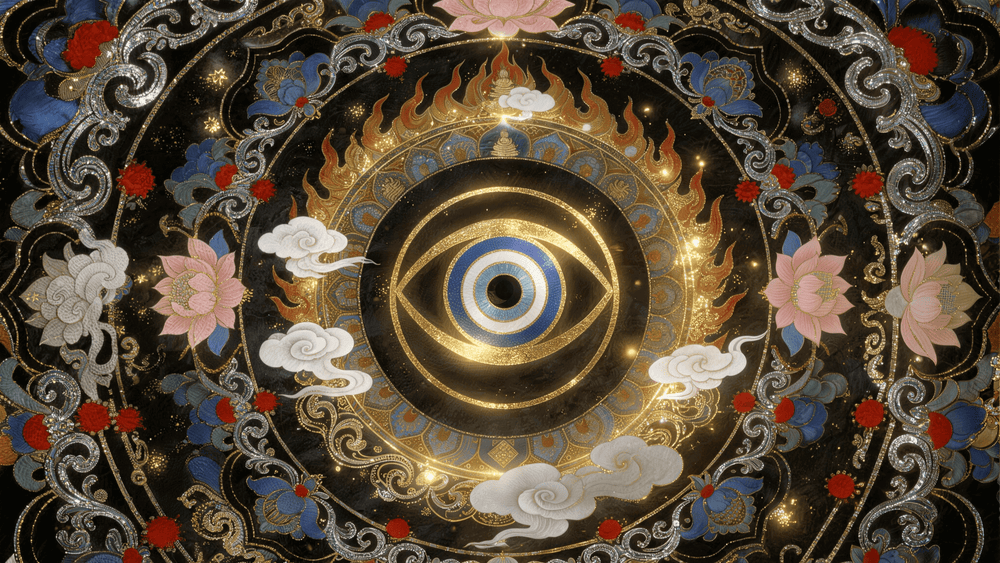
Evil Eye Symbol Meaning: Protection, Awareness, and Boundaries
The Evil Eye symbol is a protective eye motif connected with envy, unwanted attention, visibility, and personal boundaries. In many traditions, the symbol is used as a response to the belief that a jealous or harmful gaze can disturb a person's peace, luck, or sense of safety. In modern jewelry, its strongest meaning is not fear. It is awareness: a visible reminder to notice what affects you, protect your energy, and move through attention without absorbing everything around you.
That distinction matters. If the Evil Eye is explained only as a curse, it can make the wearer anxious. If it is treated only as a fashion graphic, it becomes shallow. TheFuMaster's interpretation sits between those extremes: the Evil Eye is a boundary symbol, a protection symbol, and a daily reminder that not every gaze, opinion, comment, or expectation deserves access to your inner state.
There is also a quieter reason people search for the Evil Eye. They are often not just randomly curious. Something in the symbol has already caught their attention. A seed has been planted. When a person starts to take a symbol seriously, belief itself begins to shape what they notice, what they protect, and what they choose. This is the grounded side of manifestation: not asking an object to create an outcome, but letting a visible symbol help attention, belief, and action move in the same direction.
The Evil Eye does not ask you to fear being seen. It asks you to stay awake while being seen.
What Does the Evil Eye Symbol Mean?
The Evil Eye symbol means protection from envy, harmful attention, and the emotional weight of being watched, judged, compared, or exposed. Traditionally, the "evil eye" is the harmful gaze itself. The eye-shaped protective piece that many people wear is the response to that gaze. This is why the symbol looks back. It meets attention with attention.
In plain language, the Evil Eye is about the relationship between visibility and boundary. When a person becomes more visible through beauty, success, love, wealth, pregnancy, a new job, a new home, or a new chapter, they may also feel more exposed. The symbol gives that exposure a form. It says: I can be visible without becoming unguarded.
For TheFuMaster, this makes the Evil Eye especially relevant for people who feel sensitive to social pressure. The pressure may come from public attention, family expectations, workplace comparison, online judgment, travel, dating, business visibility, or simply the feeling that too many people are looking at your life. The symbol is not a wall. It is a filter.
Where Does the Evil Eye Belief Come From?
The Evil Eye belief appears across many regions, including Mediterranean, Middle Eastern, North African, South Asian, Latin American, Greek, Roman, and wider folk traditions. The details change by culture, but the central pattern stays similar: envy, praise, or excessive attention can carry force, and a protective object can help turn that force away.
This wide cultural spread is one reason the symbol has lasted. It is not tied to one narrow modern trend. It answers a very old human concern: what happens when another person's attention is not neutral? Many communities used protective objects, gestures, blue beads, written protections, household symbols, and other forms to respond to that concern. Jewelry became one of the most wearable forms because it stays close to the body.
The familiar blue-and-white eye is often associated with the Nazar bead, especially in Turkish and nearby traditions. Other cultures use different forms, colors, hands, horns, written symbols, or household objects. The shared idea is not that one object controls fate. The shared idea is that protection can be made visible, carried, gifted, and remembered.
Why Is the Evil Eye Connected With Envy?
The Evil Eye is closely linked with envy because envy is attention mixed with lack. Someone sees what another person has, wants it, resents it, or cannot bless it cleanly. In folk belief, that kind of gaze is not harmless. It can become heavy, intrusive, or disturbing. Whether a person reads this literally or symbolically, the emotional truth is easy to understand.
Most people have felt the difference between warm attention and invasive attention. Warm attention gives room. Invasive attention takes something. A compliment can feel supportive, but it can also feel possessive, competitive, or strange. A look can feel kind, but it can also feel measuring. The Evil Eye symbol turns that felt difference into an object you can carry.
This is why TheFuMaster does not frame the Evil Eye as a panic symbol. The healthier interpretation is discernment. You do not need to believe every gaze has power over you. You do need to learn which attention you let in, which attention you ignore, and which situations require stronger boundaries.
Is the Evil Eye a Curse or a Protection Symbol?
Strictly speaking, the "evil eye" is the harmful gaze. The eye-shaped jewelry people wear is the protection symbol. In daily language, both are often called the Evil Eye, which can create confusion. When someone says they wear an Evil Eye bracelet, they usually mean they wear a protective eye symbol, not that they are wearing a curse.
This difference is important for trust. A protective symbol should not make the wearer feel haunted, dependent, or afraid of ordinary life. It should help the wearer return to steadiness. If a piece of jewelry makes you feel more anxious, it is not serving its purpose. Meaningful jewelry should support attention, not control it.
The best way to understand Evil Eye jewelry is this: it gives protection a visible shape. It does not guarantee that nothing difficult will happen. It does not promise to remove envy, conflict, or stress. It reminds you to stay clear, centered, and selective about what you receive.
Why Is the Evil Eye Usually Blue?
The most recognizable Evil Eye form is blue because blue has long been associated with the Nazar bead and with cool, watchful protection. Dark blue can feel deep, traditional, and direct. Light blue or turquoise can feel calmer, more open, and easier for everyday styling. The concentric circles of blue, white, and dark center also visually resemble an eye that reflects attention back outward.
For modern jewelry, blue works because it is protective without feeling aggressive. Red can feel active and bold. Black can feel heavy and grounding. Gold can feel warm and visible. Silver can feel clean and quiet. Blue holds a middle position: alert, calm, and clear. It is one reason blue Evil Eye bracelets, earrings, and rings remain common across both cultural and fashion contexts.
Color meanings vary by tradition, so they should not be treated as fixed laws. A better way to choose is by emotional function. Choose blue when you want calm protection. Choose red when you want courage and visible strength. Choose silver when you want subtle daily awareness. Choose gold when you want a warmer protective accent. The color should match the kind of boundary you actually need.
What Does Evil Eye Jewelry Mean Today?
Today, Evil Eye jewelry means protective awareness in wearable form. Some people wear it because of family tradition. Some wear it because they grew up around the symbol. Some wear it because they feel drawn to its protective meaning. Others first meet it through fashion, then later learn the cultural background. The meaning becomes stronger when the wearer understands what the symbol is carrying.
In TheFuMaster's language, Evil Eye jewelry belongs to protection and boundary intention. It can support a person who wants to move through attention without becoming tense. It can also be a good symbol for people who feel easily affected by criticism, comparison, gossip, social media, workplace politics, or emotional pressure from others.
This is where belief matters. To believe in a symbol does not mean handing your life to it. It means giving your attention a form. If you believe the Evil Eye represents protected visibility, you may become more aware of when you are oversharing, absorbing judgment, or letting other people's gaze decide your mood. That awareness can change behavior. In that sense, the power of belief is not vague. It is practical.
Manifestation works best in that same grounded way. A wish becomes stronger when it turns into attention, and attention becomes stronger when it turns into repeated choices. Evil Eye jewelry can support the manifestation of better boundaries because it keeps the idea visible: I choose what enters my space. I can be seen without becoming available to every opinion. I can protect my peace and still move openly through the world.
The piece does not need to be loud. A small ring, a bracelet bead, or a pair of huggie earrings can all carry the symbol. The point is not size. The point is whether you notice it at the right moment. A useful Evil Eye piece should interrupt the moment when you are about to absorb something that does not belong to you.

When Should You Wear the Evil Eye Symbol?
Wear the Evil Eye symbol when you want a reminder of boundary, visibility, and emotional steadiness. It is especially meaningful during seasons when more people are looking at you, judging you, expecting from you, or projecting onto you. That can include a new job, a business launch, travel, a public event, dating, family gatherings, interviews, school, social media activity, or any situation where you feel watched.
It can also be useful during quieter moments. Some people wear protection symbols not because they are afraid, but because they want to stay clean in their attention. They want to remember what is theirs and what is not. They want to move through noise without becoming noise.
If your life currently feels exposed, the Evil Eye can be a good symbol. If your life currently needs grounding more than protection, black obsidian or grounding stones may fit better. If your life needs courage, red string or dragon symbolism may feel more active. If your life needs balance, Yin Yang may be clearer. The best symbol is the one that names your real need.
How Do You Choose Between a Bracelet, Ring, or Earrings?
Choose the form based on where you want the reminder to live. A bracelet is active because you see your wrist during work, movement, and daily tasks. It is good for people who want a frequent physical reminder: pause, filter, do not absorb. The Red Rope Evil Eye Bracelet is the most direct TheFuMaster example because the red cord adds courage and the blue eye bead adds watchful protection.
A ring or earrings can make the symbol feel more personal and inward. They may suit someone who wants the Evil Eye close to everyday gestures, especially during emotional transitions, social pressure, or relationship stress. The Silver Evil Eye Open Ring keeps the motif visible on the hand, while the Silver Evil Eye Huggie Earrings keep the symbol close to the face without making it feel heavy.
Rings are useful when you want a symbol on the hand, where decisions become action. You see a ring when you type, sign, gesture, reach, pay, hold, and choose. A ring can make the boundary feel active. The Silver Evil Eye Open Ring and Gold Evil Eye Open Ring both work for people who want the symbol to stay visible but not overwhelming.
Earrings frame the face and the gaze. That makes Evil Eye earrings symbolically strong: the eye motif sits near your own eyes, close to how you meet the world. The Silver Evil Eye Huggie Earrings are a quieter option for people who want protective meaning without a larger bracelet or ring.
What Is the Difference Between Evil Eye and Hamsa?
The Evil Eye and Hamsa are often seen together, but they are not the same symbol. The Evil Eye is usually an eye motif connected with watchfulness, envy, and protection from harmful attention. The Hamsa is usually a hand-shaped symbol connected with protection, care, strength, and held safety. In some designs, the Hamsa includes an eye in the palm, bringing both meanings together.
If you want a symbol focused on gaze, envy, and visibility, Evil Eye is more direct. If you want a broader care-and-protection symbol, Hamsa may feel more expansive. If you are choosing jewelry for TheFuMaster's symbolic system, Evil Eye is best for boundary and protected awareness, while Hamsa would sit closer to care, steadiness, and held protection.
Do not choose only by popularity. Choose by function. A person who feels watched, judged, or socially exposed may connect more strongly with Evil Eye. A person who wants a general symbol of care and protection may prefer Hamsa. The meaning should meet the actual season of life.
Can You Wear the Evil Eye If It Is Not From Your Own Culture?
This is a fair question because the Evil Eye is not just a decorative shape. It comes from living cultural traditions. At the same time, it is also a widely shared symbol across many regions, families, and folk practices. There is no single modern owner of the symbol, but that does not mean it should be worn carelessly.
The respectful approach is simple: know what it means, avoid treating it as a costume, and do not make fake claims you cannot prove. Do not reduce it to a trendy blue icon. Do not pretend it belongs to a tradition you have not studied. Do not use it to frighten people. Wear it as a protective symbol with awareness, humility, and clear intention.
For TheFuMaster, this is why the article keeps returning to boundary rather than superstition. Boundary is a human experience. The cultural symbol gives that experience a form. The wearer should respect the form while using it in a grounded, modern way.
Does Evil Eye Jewelry Actually Protect You?
The honest answer is: Evil Eye jewelry is traditionally used as a protection symbol, but it should not be treated as a guaranteed shield. It cannot promise that nothing bad will happen. It cannot replace judgment, boundaries, rest, support, legal action, or ordinary practical care. Its value is symbolic and behavioral.
Symbolic does not mean meaningless. A symbol can change what you notice. It can remind you to leave a conversation, ignore a comment, stop explaining yourself, protect private plans, keep success quiet until it is stable, or return to your own center when someone's attention feels invasive. That is real value, but it is not magic in the shallow sense.
This is the difference between fear-based protection and grounded protection. Fear-based protection says: the world is dangerous, and you are powerless without this object. Grounded protection says: your attention matters, your peace matters, and this object helps you remember to guard both.
What Should You Do If an Evil Eye Bracelet Breaks?
Many traditions interpret a broken Evil Eye bracelet or bead as a sign that the object has absorbed or deflected negative energy. Some people replace it immediately. Some thank it and let it go. Others treat the break practically: cord wears down, beads chip, metal weakens, and jewelry has a physical life span. Both symbolic and practical readings can exist at the same time.
TheFuMaster's grounded answer is this: do not panic. Notice how the piece broke, what was happening in your life, and whether replacing it feels meaningful. If the break feels symbolic to you, treat it respectfully. If it simply looks like wear and tear, repair or replace it as you would any other jewelry. The meaning should support steadiness, not superstition anxiety.
If you replace the piece, choose with intention rather than fear. Ask: what kind of boundary do I need now? A red rope bracelet may fit active daily protection. A silver ring may fit subtle awareness. Earrings may fit calm watchfulness. The replacement should feel clearer, not more nervous.
How to Wear the Evil Eye as a Daily Boundary Reminder
Wearing the Evil Eye does not need a special process. Keep it practical. Before putting it on, pause long enough to name the boundary you want to remember that day. You might say: "I protect my peace." Or: "I choose what I receive." Or: "I stay visible without becoming open to everything."
After that, put the piece on and let it work as a visual reminder. It is not a force for controlling the outside world. It is a quiet cue that brings your attention back to what you already decided. The value is not in making the world less complex. The value is in helping you move through it with more clarity.
Return to the sentence when the symbol catches your eye. If you see the bracelet while answering a message, ask whether the reply deserves your energy. If you notice the ring during a meeting, ask whether you are staying clear. If you notice the earrings before leaving home, ask whether you are carrying someone else's pressure. This is how jewelry becomes a daily reminder rather than a fear object.
Hold the symbol with respect, not tension. The point is not to make the Evil Eye do the work for you. The point is to let it strengthen the direction you already chose. If your manifestation is better boundaries, then every glance at the symbol can become a return to that direction: notice, choose, act, repeat.
How the Evil Eye Fits TheFuMaster's Protection Jewelry
The Evil Eye is one part of a wider protection language. Black obsidian gives grounding and energetic weight. Red string gives active connection and vitality. Pixiu gives guarded prosperity and disciplined receiving. The Evil Eye gives boundary under attention. These symbols overlap, but they do not do the same emotional work.
If you are choosing by intention, start with the problem you want the jewelry to help you remember. If your problem is scattered energy, choose grounding. If your problem is fear of visibility, choose Evil Eye. If your problem is protecting money and opportunity, choose Pixiu. If your problem is emotional overextension, choose a piece that brings you back to boundary and calm.
TheFuMaster's view is that a symbol deserves respect. A person who comes to the Evil Eye may already be carrying a private question: how do I stay protected while becoming more visible? How do I stop absorbing what does not belong to me? How do I believe in my own peace strongly enough to protect it? Those questions are the beginning of meaning. The jewelry does not answer them alone, but it can help the wearer keep returning to them.
This is also why manifestation can belong naturally in protection jewelry. Manifestation is not only about attracting something new. Sometimes it is about becoming loyal to a boundary, a calmer identity, or a clearer way of moving through attention. The Evil Eye supports that by making the direction visible.
You can compare styles in TheFuMaster's Evil Eye Symbol Jewelry collection, or read the broader Symbols & Meaning guide if you are still deciding between Evil Eye, Pixiu, Lotus, Yin Yang, Tree of Life, Dragon, and other symbolic jewelry.
Common Mistakes When Choosing Evil Eye Jewelry
The first mistake is choosing only because the design is popular. A symbol becomes stronger when you understand it. If you only want a blue accent, that is fine, but do not confuse decoration with intention. If you want the symbolic meaning, take a moment to learn what the eye represents.
The second mistake is turning the symbol into fear. If you start reading every delay, every lost item, every bad mood, or every strange look as proof that something is attacking you, the symbol is no longer helping. Protection should restore calm. It should not make the world feel more threatening.
The third mistake is choosing a piece that does not fit your real life. A bracelet that bothers your wrist will not become a daily reminder. A ring that feels distracting may stay in a drawer. Earrings that do not match your routine may be forgotten. Choose the form you will actually wear.
The fourth mistake is expecting the jewelry to do your boundary work for you. The Evil Eye can remind you to protect your peace, but you still need to say no, leave the room, stop oversharing, protect your plans, choose your audience, and move with discretion when needed.
How to Know If the Evil Eye Is the Right Symbol for You
The Evil Eye is right for you if the word "boundary" feels important right now. It may also be right if you feel more visible than usual, if you are stepping into a new phase, if you are tired of absorbing other people's moods, or if you want a symbol that feels protective without being heavy.
It may not be the best symbol if you are looking for softness, romance, or emotional opening. In that case, rose quartz, lotus, or heart-centered symbols may fit better. It may also not be the best symbol if it makes you feel fearful. A good symbol should bring you closer to steadiness. If it creates tension, choose another path.
The simplest test is this: when you look at the Evil Eye, do you feel watched in a bad way, or reminded to watch over yourself? If it is the second, the symbol may be useful. If it is the first, you may need a gentler form of protection.
FAQ
What does the Evil Eye symbolize?
The Evil Eye symbolizes protection, awareness, and boundary under attention. It is traditionally connected with envy or harmful gazes, but in modern jewelry it can be understood as a reminder to protect your peace and choose what you receive.
Is Evil Eye jewelry a curse?
No. The harmful gaze is the "evil eye" in traditional belief. The eye-shaped jewelry people wear is usually the protective symbol used to answer that gaze. It should be understood as symbolic protection, not as a curse.
Can anyone wear Evil Eye jewelry?
Anyone can wear Evil Eye jewelry respectfully if they understand its protective meaning and do not treat it as an empty trend or fake guarantee. The best approach is to wear it with awareness, humility, and clear intention.
Which Evil Eye color is best for protection?
Dark blue is the most traditional and recognizable color for general Evil Eye protection. Light blue feels calmer, red feels more active, silver feels subtle, and gold feels warmer. Choose the color that matches the kind of boundary you need.
Should I wear an Evil Eye bracelet on the left or right wrist?
Many traditions connect the left side with receiving energy, so some people prefer the left wrist for protective bracelets. TheFuMaster's grounded view is that placement matters less than intention and daily wearability. Wear it where it reminds you most clearly.
What does it mean if an Evil Eye bracelet breaks?
Some traditions read a broken Evil Eye piece as a sign that it has absorbed or deflected negative energy. It can also simply mean the cord, bead, or metal wore down. Do not panic. Replace or repair it if doing so feels meaningful and steady.
Is the Evil Eye the same as Hamsa?
No. The Evil Eye is usually an eye motif connected with gaze, envy, and protection from harmful attention. Hamsa is a hand-shaped symbol connected with protection, care, and held safety. Some designs combine both.
Does Evil Eye jewelry guarantee protection?
No. Evil Eye jewelry should not be treated as a guaranteed shield. Its value is symbolic and practical: it reminds the wearer to stay aware, protect boundaries, and avoid absorbing attention or pressure that does not belong to them.