Bracelets for Calm: How Touch Can Support Grounding
A bracelet for calm should not be treated as a cure, a guarantee, or a replacement for real care. Its value is simpler and more grounded: it gives attention a physical place to return. When the mind feels loud, touching beads, noticing texture, and breathing with repetition can help a person come back to the present moment with more steadiness.
A bracelet is not a cure. It is a place for attention to return.
The strongest way to write about calming bracelets is also the most honest way: a bracelet cannot fix a person's life, health, stress, or emotional state. It should not be described as a treatment, and it should never make someone feel that jewelry can replace professional support, medical care, therapy, rest, conversation, planning, or ordinary responsibility.
What a bracelet can do is much smaller, and because it is smaller, it is more believable. It can become a tactile anchor. It gives the hand something specific to touch when attention feels scattered. It gives the body a detail to notice: one bead, one surface, one weight, one point of contact. That small return can create a pause.
A pause matters because many difficult moments move quickly. A thought becomes a reaction. A reaction becomes a message, a purchase, an argument, a withdrawal, or a decision made from pressure. A bracelet does not remove the pressure. It can help create one narrow space between feeling and action.
This is the right frame for TheFuMaster: meaningful jewelry is not here to handle life for the wearer. It is here to help the wearer remember where to return. The object is not the power. The return is the power, repeated patiently.
Why touch helps when the mind feels loud
When the mind feels loud, it often moves in abstractions: what if, why did this happen, what will they think, what if I fail, what if I am late, what if this never changes? Abstract thoughts can multiply quickly because they do not have a clear edge. Touch is different. Touch has an edge. It is immediate, physical, and located in the body.
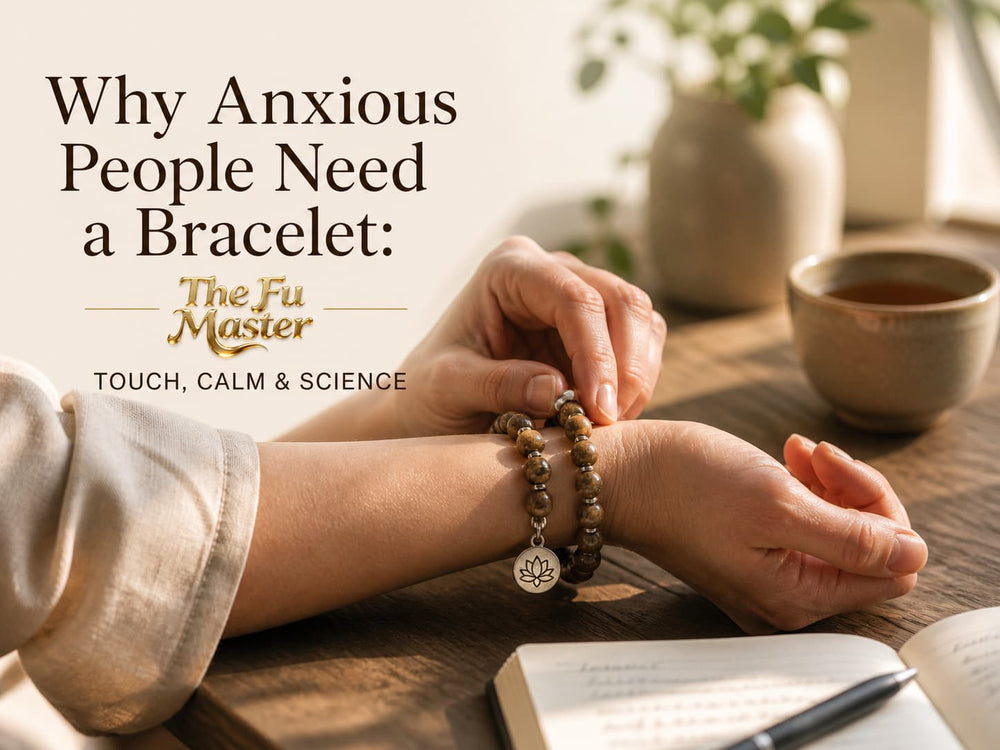
A bead has temperature. A woven cord has texture. A stone has weight. A bracelet sits against the wrist and moves with the hand. These details do not require a person to believe a claim. They only ask the person to notice what is already there.
This is why tactile objects can feel useful in grounding. They bring attention away from a mental loop and toward a sensory fact. The fact may be simple: this bead is cool, this cord is rough, this edge is smooth, this bracelet is resting against my wrist. That simplicity is the point. A grounded moment often begins when attention stops trying to solve everything at once and returns to one real thing.
The bracelet is not calming because it is magical. It is calming when it helps the wearer slow the movement of attention. Touch becomes a door back into the present.
Grounding is the art of returning to the present
Grounding is often described through the senses because the senses pull attention into the present moment. The Cleveland Clinic explains grounding techniques as ways to connect with the present through physical and mental exercises. The NIH Office of Intramural Training & Education also describes grounding through the five senses, including things a person can touch.
This does not mean a bracelet is a clinical tool. It means the bracelet can fit inside a broader, everyday logic: when attention is scattered, a clear sensory detail can help gather it. Touch, breath, sight, sound, and movement are all ways to return to what is happening now.
Mayo Clinic describes mindfulness as awareness of the present moment, and its examples often bring attention back to breathing, the body, and daily activities. A bracelet can be one small object inside that kind of awareness. It is not the whole method. It is a reminder that fits on the body.
This distinction protects the meaning. If a bracelet is asked to promise too much, it becomes untrustworthy. If it is allowed to do one small job well, it becomes useful: it gives the wearer something concrete to return to.
Why bracelets work better than loose objects for some people
A person can use many objects for grounding: a smooth stone, a key, a ring, a notebook, a cup, the edge of a table, the feeling of shoes on the floor. A bracelet is not the only option. Its advantage is availability.
A loose object must be found. A bracelet is already there. It sits near the hand, and the hand naturally meets the world. The hand reaches, writes, types, drives, cooks, opens doors, holds phones, signs forms, and touches other objects. Because a bracelet travels with the hand, it can become a reminder without asking the wearer to search for it.
This makes bracelets useful in ordinary transitions: before a meeting, while waiting in line, during a commute, before replying to a message, after reading difficult news, or during the first minute after arriving home. These are not dramatic moments, but they are the places where attention often leaks away.
The best symbolic jewelry is not only meaningful in a photograph. It is meaningful when life is slightly messy. A bracelet is close enough to be noticed in those small moments.
Beads, texture, weight, and repetition
Not every bracelet feels the same. If the purpose is grounding, the physical qualities matter. The reader should not choose only by color or a promised benefit. They should ask what the hand will actually feel.
Beads create sequence. Moving from one bead to the next gives attention a path. This is different from touching a flat surface. A bead says: here, then here, then here. The mind can follow that sequence without needing a complicated instruction.
Texture creates difference. Smooth wood, polished stone, woven cord, carved details, and small metal accents all speak to the hand in different ways. A bracelet with texture can be easier to notice because the hand receives small changes. Those changes keep attention from floating away too quickly.
Weight creates presence. A very light bracelet may disappear from awareness. A piece with enough weight can remind the wearer that something is there. The weight should not be uncomfortable. It should simply be real enough for the body to register.
Repetition creates return. When the same small movement is repeated, the hand begins to learn the path. Touch one bead, exhale, move to the next bead, return. Over time, the bracelet becomes associated with the act of coming back. That association is not a guarantee. It is a habit made visible.
The difference between calming jewelry and medical claims
There is a clear line between calming jewelry and medical claims. Calming jewelry can be described as a tactile anchor, a daily reminder, a symbolic object, or a piece that supports a grounding routine. It should not be described as a cure, a treatment, a panic solution, or a guaranteed stress remover.
This boundary is not only about compliance. It is about respect. A person who is struggling deserves language that does not exaggerate. Selling certainty where certainty does not exist weakens trust. It also weakens the spiritual meaning of the object because it asks the object to perform a job it cannot honestly perform.
The better promise is smaller: this bracelet can help you remember to return. It can help you notice touch, breath, and repetition. It can become part of a grounded moment. It can carry a symbol you choose to respect. It can sit on the wrist as a visible reminder of steadiness.
That is enough. A meaningful object does not need to pretend to be medicine in order to matter.
How to use a bracelet as a 60-second grounding anchor
This simple reset is not a formal performance. It does not require special words, special timing, or special belief. It is a practical way to let touch lead attention back to the body.
- Notice one bead. Choose one point on the bracelet and let your thumb rest there.
- Feel the surface. Notice whether it is smooth, cool, warm, heavy, light, round, carved, or textured.
- Move slowly. Let your thumb move to the next bead or next section of the bracelet without rushing.
- Lengthen the exhale. Breathe in naturally, then let the breath out a little more slowly.
- Ask one steady question. Try: what is the next choice I can make from a steadier place?
The reset works best when it stays simple. If it becomes too elaborate, it can turn into another task. The point is not performance. The point is return.
This is also where respect enters. A small action can look ordinary from the outside, but it may be meaningful to the person doing it. The bracelet becomes a way of saying: I am not ignoring this moment. I am meeting it with more attention.
Choosing a bracelet by the kind of return you need
Different materials and forms create different kinds of return. The best choice is not the bracelet with the strongest claim. The best choice is the one your hand and attention will actually use.
Wood beads often feel warm and natural. They suit people who want a softer tactile object, something that feels close to daily life rather than formal or heavy. Wood can be useful when the desired return is gentle and human.
Stone beads often carry more weight. Jasper, onyx, jade-style stones, lapis lazuli, chalcedony, and other stones each have their own look and feel, but the grounding effect comes partly from the physical reality of the material. Weight can help the body register the object more clearly.
Woven bracelets create another kind of touch. Cord, knots, and braided structure bring texture and flexibility. They can feel more casual and easier to wear every day. For someone who wants a grounding object without a polished gemstone look, woven forms can feel more approachable.
Symbols also matter, but they should not overpower the tactile logic. A Tree of Life can point to rootedness. A lotus can point to renewal. Blue stones can suggest composed expression. Green elements can suggest return and gentle growth. These meanings are useful when they help the wearer remember the kind of return they are choosing.
What to avoid when shopping for calming jewelry
The easiest way for calming jewelry to lose trust is to promise too much. Be cautious when a product description turns a bracelet into a guaranteed emotional result. Words like "instant," "always," "remove," and "fix" should make the reader slow down. A meaningful object can be useful without pretending to control the whole nervous system.
Also be cautious when the copy makes the buyer feel dependent. Good symbolic jewelry should strengthen responsibility. It should not make a person feel that they are unsafe, incomplete, or unlucky without the object. The difference is subtle but important. Responsible language says: this piece can remind you to return. Irresponsible language says: without this piece, you cannot return.
Material language matters too. If the article or product page speaks about wood, jasper, onyx, jade-style beads, bodhi root, chalcedony, or lapis lazuli, the reader should be able to understand the basic material direction. A symbolic bracelet does not need to be rare to be meaningful, but it should not hide behind vague claims. Honesty makes the meaning stronger.
The best purchase question is not "which bracelet has the strongest promise?" It is: which object can I live with, touch often, and use as a steady reminder without becoming dependent on it? That question keeps the buying decision mature.
When a bracelet is not enough
A grounded guide must also say when the object is not enough. If a person's distress feels intense, repeated, unsafe, or impossible to manage alone, a bracelet should not be treated as the answer. It may still be a comforting object, but comfort is not the same as care. Professional help, trusted people, rest, and practical support may be necessary.
This point does not make the bracelet meaningless. It puts the bracelet in the right place. A cup can help someone drink water, but it is not the water. A notebook can help someone organize a plan, but it is not the plan. A bracelet can help attention return, but it is not the whole return. The person still needs breath, choice, support, and action.
This boundary is especially important for a brand that wants long-term trust. TheFuMaster should not use a person's vulnerable moment as a sales shortcut. The better role is to offer language that is warm, clear, and grounded: if this object helps you remember steadiness, use it well. If you need more than a reminder, respect that need too.
Manifestation through repetition: belief made touchable
Manifestation is often weakened by language that makes the outside world responsible for the result. A more grounded definition is better: manifestation is belief becoming behavior. It happens when a person believes in a direction strongly enough to notice it, return to it, and act from it again and again.
A bracelet can make that process touchable. It turns an inner sentence into an outer reminder. The wearer is not saying, "this object will make me calm." The wearer is saying, "I believe I can return to steadiness, and I am willing to repeat the return."
This is the power of belief when it is treated with respect. Belief is not a fantasy. Belief changes attention. Attention changes repeated choices. Repeated choices change the shape of a day. Days become habits, and habits become character.
In this sense, a bracelet can be more than decoration without becoming a false promise. It can be a small witness to the wearer's return. Each touch says: I remember what I am practicing in life. I remember the state I want to feed. I remember that one steady choice still matters.
How TheFuMaster reads calm: not silence, but steadiness
Calm is often misunderstood as having no noise, no pressure, no conflict, and no emotion. That is not realistic. A better definition is steadiness. A calm person may still feel pressure, but they are not completely ruled by it. They may still have thoughts, but they can choose the next action with more care.
This matters for symbolic jewelry because the object should not promise a silent life. It should point toward a steadier relationship with life. A bracelet for calm is not saying that nothing difficult will happen. It is saying: when difficulty happens, return to the body, return to attention, return to one deliberate choice.
That is why the hand is important. The hand is where intention becomes action. The hand sends the message, signs the paper, pays the bill, holds the cup, opens the door, creates the work, and reaches for another person. A bracelet sits near action. It reminds the wearer that calm is not only a feeling. It is also a way to move.
Bracelet examples for tactile grounding
If this way of reading bracelets feels right, choose by touch, symbol, and daily fit. The product should serve the reminder, not replace it.
The Tree of Life Jasper Woven Bracelet is a strong example for rooted steadiness. Jasper and onyx beads bring weight and texture, while the woven structure keeps the piece relaxed enough for daily wear. The Tree of Life symbol also fits the article's central idea: attention needs roots.

The Lotus Green Wood Bead Bracelet fits a gentler kind of return. Its wood-style beads and lotus symbol make it suitable for someone who wants softness, renewal, and a warmer tactile surface.
The Bodhi Root Bead Bracelet is useful when the main need is simple bead repetition. Its value is not in a dramatic claim. It is in the smooth, repeatable contact of bead after bead during everyday wear.
For broader options, the Calm & Balance collection gathers pieces chosen for steadiness and composed presence, while the Bracelets collection is the better place to compare forms, textures, and daily wearability.
FAQ
Can a bracelet help with grounding?
A bracelet can help as a tactile grounding anchor when it gives your hand and attention something physical to return to. It should be understood as a reminder, not a cure or guarantee.
Is a bracelet a treatment for anxiety?
No. A bracelet is not a medical treatment and should not replace professional support. It can be part of a personal grounding routine through touch, breath, and repetition.
Why do beads feel calming to touch?
Beads give attention a clear sequence. Moving from one bead to the next can slow the hand, organize attention, and create a small pause before the next action.
What materials are best for a calming bracelet?
Choose by touch. Wood can feel warm, stone can feel weighty, woven cord can feel textured, and smooth beads can support repetition. The best material is the one you will actually notice and use.
How do I use a bracelet as a grounding anchor?
Touch one bead, notice its surface, move slowly to the next bead, breathe out longer than usual, and ask what the next steady choice is. Keep it simple and repeatable.
Is this the same as fidget jewelry?
There is overlap. Fidget jewelry often gives the hand something to do, while grounding jewelry adds symbolic meaning and a deliberate return to attention, breath, and choice.
What should I avoid when buying calming jewelry?
Avoid products that promise guaranteed calm, guaranteed relief, medical results, or instant transformation. Good symbolic jewelry should make you more grounded and responsible, not dependent on a claim.
Can grounding jewelry help with manifestation?
It can help in a grounded way if it turns belief into repeated attention and behavior. The jewelry does not create the outcome for you. It helps you remember the direction you choose to feed.