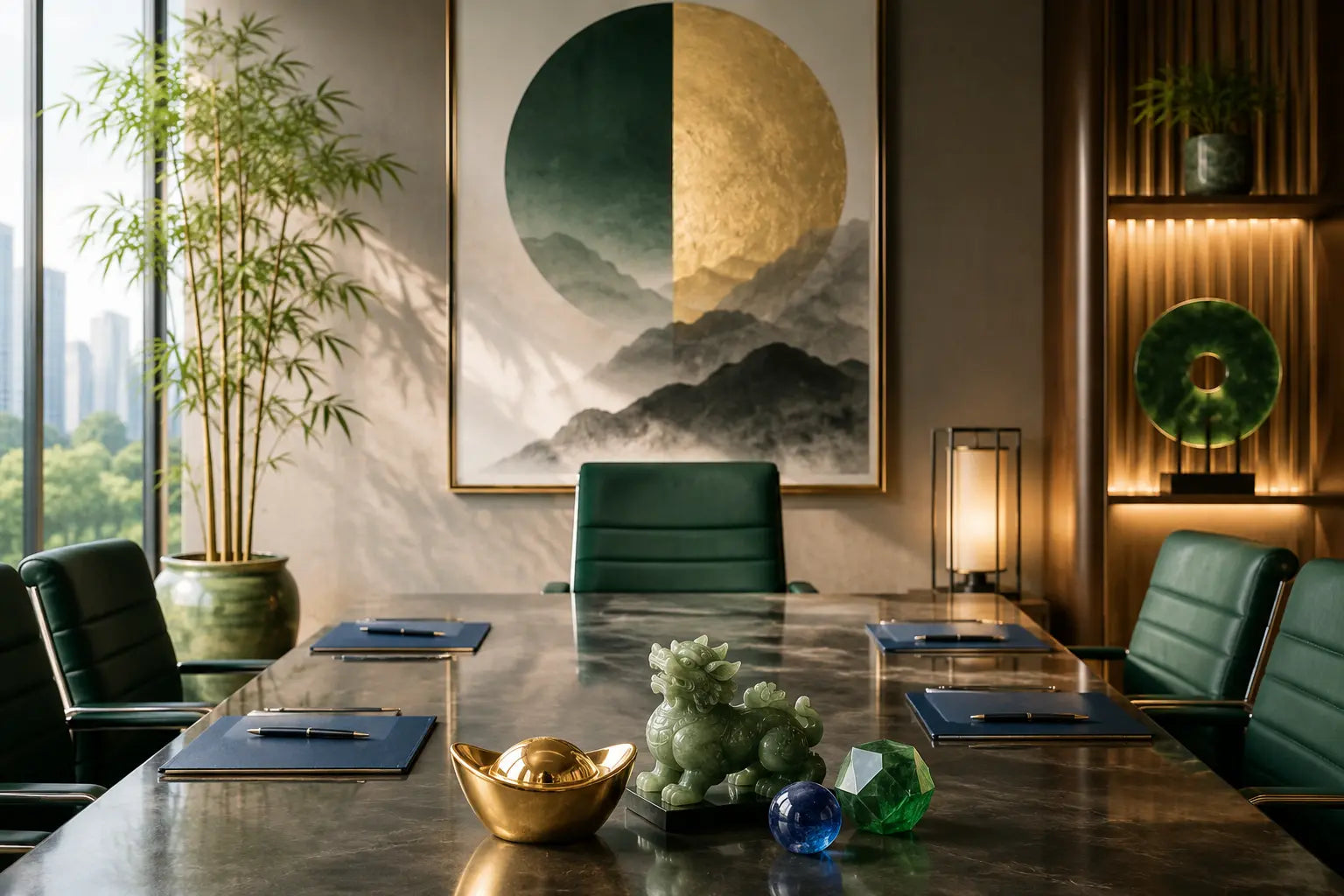
Lucky Color for a Business Meeting: A Feng Shui Guide
The best lucky color for a business meeting is the color that supports the state the meeting needs. Choose blue for trust and clear communication, green for growth and cooperation, brown or Tiger Eye tones for grounded judgment, gold for confident value, red as a small visibility accent, and black, navy, or gray for authority. The color works best as a practical cue for how you want to speak, listen, decide, and follow through.
In Feng Shui-inspired dressing, color is more than decoration. It is a language of mood, role, and direction. A business meeting is not one single situation. A first client conversation asks for trust. A sales presentation asks for confident value. A price discussion asks for steadiness. A partnership meeting asks for growth. A difficult scope conversation asks for calm boundaries. The most useful color is the one that helps you enter the room with the right behavior.
That is the TheFuMaster approach to lucky color: not a shortcut, not a costume, and not a loud sign of ambition. It is a small way to align appearance, intention, and action. When the color is carried through a bracelet, ring, clothing detail, notebook, scarf, or tie, it can become a repeatable reminder during the exact moments when business depends on clarity.
What is the best lucky color for a business meeting?
For most business meetings, blue is the safest lucky color because it signals trust, calm authority, and clear communication. If you do not know the room yet, blue rarely feels too aggressive or too casual. A navy jacket, blue shirt, blue accessory, or blue-toned bracelet can help the whole look feel composed and professional.
That does not make blue the only good answer. The best color depends on the meeting goal. Green is stronger when the conversation is about growth, collaboration, hiring, new projects, or long-term planning. Brown and Tiger Eye tones are stronger when the meeting is about delivery, pricing, contracts, or steady judgment. Gold is useful when you need to present value with confidence. Red can help visibility, but it should usually stay small. Black, navy, and gray are useful when the room needs authority, structure, and a clean professional line.
A simple way to choose is to ask: what does this room need from me? If it needs trust, start with blue. If it needs growth, add green. If it needs a stable decision, choose brown or Tiger Eye tones. If it needs value, add a small gold accent. If it needs presence, use red carefully. If it needs boundaries, use black, navy, or gray.
Lucky color works best in business when it supports behavior: clearer words, better timing, steadier judgment, and the courage to make a direct ask.
Start with the type of meeting, not the color
The first mistake is choosing a color before understanding the meeting. A client discovery call is not the same as a pitch. A pitch is not the same as a negotiation. A negotiation is not the same as an internal leadership meeting. Each room has a different emotional task, and the color should match that task.
For a first client meeting, the goal is usually trust. You want the other person to feel that you are prepared, attentive, and easy to speak with. Blue, navy, soft green, or earth tones work well because they reduce visual noise and support a stable impression. The color should say, "You can speak clearly here."
For a pitch, the goal is value. You need the room to understand why your offer matters, why the timing matters, and why you are confident enough to ask for the next step. Blue can still work, but a gold accent, Tiger Eye bracelet, or sharp brown detail can add more presence. The color should say, "This offer has weight."
For a negotiation, the goal is discipline. You need to listen, avoid over-explaining, and hold your position without becoming rigid. Brown, Tiger Eye tones, navy, gray, and black can all support a steadier posture. The color should say, "I am calm, but I know my line."
For a partnership or growth meeting, the goal is possibility. Green, teal, soft blue, and gold accents can help the visual message feel open and constructive. The color should say, "There is room to build this well."
For a difficult meeting, the goal is control of tone. Avoid colors that make you feel heated, flashy, or self-conscious. Choose a palette that helps you stay measured. Deep blue, charcoal, brown, and simple black can help you look serious without adding more tension to the room.
Blue for trust and clear communication
Blue is the strongest all-purpose business meeting color because it is widely read as trustworthy, competent, calm, and professional. It has enough authority for a serious room, but it does not carry the same heat as red or the same distance as full black. This is why blue appears so often in business branding, formal shirts, suits, and professional accessories.
In Feng Shui color language, blue is often connected with water: flow, depth, reflection, and career movement. For business meetings, that symbolism is useful when the goal is not to dominate the room but to keep the conversation moving with clarity. Blue helps the wearer remember to listen, ask better questions, and respond with a cooler rhythm.
Dark blue is best for authority. It works well for executives, consultants, founders, lawyers, finance conversations, and high-trust client meetings. Soft blue is better when the room needs openness, empathy, or less pressure. Blue-green and teal can work when the meeting sits between strategy and growth: enough calm to stay clear, enough life to suggest momentum.
Wear blue when your main intention is: I will listen before I answer, speak clearly, and move the conversation forward without forcing the room. That sentence is practical. It changes how you carry yourself more than any color alone could.
Green for growth, cooperation, and new opportunity
Green is the color to consider when the meeting is about expansion. It can fit partnership discussions, hiring conversations, creative planning, early-stage investment talks, product roadmaps, or any situation where the goal is not only to close a point, but to build something over time.
In many color systems, green suggests growth, renewal, vitality, and a more natural pace. In a business setting, this can make the room feel less hard-edged. It is useful when you want to show ambition without looking impatient. It also works when the other side needs to feel that the relationship has room to develop, not just a transaction to complete.
Green does not need to be bright. Deep green, olive, jade, forest green, and muted teal can all feel more professional than a very vivid green. A small green accent can soften a navy or gray outfit. A green stone or bead can also work well when the rest of the clothing is simple.
Wear green when your intention is: I will create space for the right opportunity to develop. This is especially useful when the conversation requires patience. Growth is not always loud. Sometimes it looks like asking one better question, giving the other side room to think, and leaving the meeting with a clear next step.
Brown and Tiger Eye tones for grounded judgment
Brown, tan, warm gray, sand, wood tones, and Tiger Eye colors are useful when the business meeting needs grounded judgment. These are not flashy colors. They suggest reliability, practicality, and follow-through. They are strong for meetings about pricing, scope, contracts, delivery, operations, logistics, vendor selection, or implementation.
Tiger Eye is especially relevant because its natural visual language sits between brown and gold. It feels steady, alert, and focused. The brown gives grounding. The golden bands add movement and confidence. For business meetings, that combination is valuable because good decisions need both: confidence to speak, and discipline to stay practical.

The Tiger Eye Sovereign Bracelet is a natural example for business-meeting wear. It does not need to be treated as a dramatic charm. Its better role is quieter: a wrist-level reminder to read the room, keep your words structured, and act with focus instead of force.
Brown and Tiger Eye tones work well with navy, cream, black, charcoal, dark green, white, and warm neutrals. They are especially useful if your business style needs to feel mature rather than flashy. In a meeting, that matters. The goal is not to look decorated. The goal is to look ready.
Gold for value and confident pricing
Gold is powerful in business because it points toward value, quality, confidence, and visibility. It can be useful when you are presenting a proposal, naming a price, asking for investment, explaining premium service, or showing why your work should be taken seriously.
The key is proportion. Too much gold can look performative, especially in a first meeting or conservative setting. A small gold accent is often better: a bracelet detail, watch tone, ring, pen, belt buckle, button, small earring, or warm metallic note in the outfit. Let gold act as a point of light, not the whole message.
In Feng Shui-inspired color language, gold often connects with value and prosperity. In business writing, that can easily become exaggerated, so keep the meaning practical. Gold should remind you not to shrink the value of what you bring. It can help when you need to speak your price with calm confidence rather than apologizing for it.
Wear gold when your intention is: I will present the value clearly. This is different from showing off. The best business gold is controlled, refined, and connected to confidence. It says that you understand the worth of the offer and can explain it with discipline.
Red as a small visibility accent
Red is strong, active, and culturally important in Chinese color symbolism. It can suggest recognition, courage, celebration, and forward movement. In a business meeting, red can help when you need to be seen, make a bold point, open a presentation, or bring more vitality to a room.
But red is also easy to overuse. In negotiation, conflict, pricing, or tense client conversations, a large red area can feel too heated. It may make the room feel more intense than it needs to be. For most business meetings, red works best as an accent rather than the main color.
A red thread detail, small bead, notebook mark, tie accent, lining, lipstick, or very small accessory can carry visibility without overwhelming the meeting. This fits TheFuMaster's broader visual rule too: red is meaningful, but it is strongest when controlled.
Wear red when your intention is: I will be visible without losing control. That balance matters. Red should help you step forward, not push the whole conversation into heat.
Black, gray, and navy for authority
Black, gray, and navy are business classics because they reduce noise. They create a clean field around the face, hands, and words. They are useful when the room needs formality, seriousness, structure, and direct decision-making.
Black can be strong when you need to hold a boundary, discuss scope, handle a difficult topic, or avoid appearing too casual. The risk is emotional distance. Too much black can feel closed if the meeting depends on warmth, trust, or early relationship building. Pairing black with brown, gold, cream, blue, or green can make it easier to approach.
Gray is useful when neutrality matters. It can be good for mediation, corporate settings, finance, operations, and meetings where you want the facts to lead. Gray does not create much emotion, which can be useful when the topic is already emotional. Add a small blue or Tiger Eye accent if the look needs more life.
Navy often gives the best balance. It has the authority of a dark color but feels less severe than black. It also pairs naturally with brown, gold, white, green, and Tiger Eye tones. For many people, navy plus one meaningful bracelet is the most reliable business meeting combination.
What color bracelet should you wear to a business meeting?
A bracelet is one of the easiest ways to use lucky color in a business meeting because it is visible but not overwhelming. You do not have to wear a full green outfit, a red jacket, or a gold-heavy look. A bracelet can hold the color message close to the hand, where business action happens: typing, presenting, shaking hands, signing, opening a notebook, or reaching for a document.
Choose the bracelet by meeting type. For a client discovery call, blue, green, or soft earth tones can support trust and openness. For a sales meeting, Tiger Eye, gold accents, or deep blue can support confidence with control. For negotiation, brown, navy, black, or Tiger Eye tones can support steady judgment. For investor or partner meetings, green with a small gold or brown accent can suggest growth and value. For difficult conversations, deep blue, gray, brown, or simple black can help the look stay measured.
The bracelet should not distract you. If it catches on sleeves, feels too loud, or makes you check your wrist too often, it is not helping the meeting. A good business bracelet should feel natural enough to forget, then meaningful enough to notice at the right moment.
For broader choices connected to clean thinking and decision-making, TheFuMaster's Clarity & Focus collection is the most natural internal path. If the meeting is about business growth, value, pricing, or opportunity, the Wealth & Prosperity collection can also fit, as long as the meaning stays grounded in behavior and business clarity.
If the reader wants to compare bracelet styles more broadly, TheFuMaster's bracelets collection gives a wider view across color, material, symbol, and daily wearability.
How to use a color cue before the meeting
A color cue should be simple. Before the meeting, look at the color or touch the bracelet once. Then name one short sentence that matches the role you need to play. The sentence should be practical enough to guide behavior.
For blue, use: "I will listen before I answer." For green: "I will build the next step clearly." For brown or Tiger Eye: "I will stay grounded and direct." For gold: "I will speak the value without shrinking." For red: "I will be visible and controlled." For black, navy, or gray: "I will hold the line with calm words."
This works because the sentence connects the color to action. It gives the mind a simple instruction. During the meeting, the bracelet or color detail can bring that instruction back. When your hand moves, the cue appears. When the conversation becomes difficult, the cue can remind you of the state you chose before entering the room.
The color cue does not replace preparation. It works best when the business foundation is already there: your numbers, your ask, your proof, your next step, your understanding of the other side, and your follow-up plan. Color helps the state. Preparation carries the meeting.
What not to wear when the meeting matters
Do not wear a color only because someone online says it is lucky. The better question is whether the color fits the room, the culture, the dress code, and the state you need. A lucky color that makes you feel uncomfortable will weaken your presence instead of strengthening it.
Do not wear a bracelet that becomes a distraction. If it is noisy, too large, too tight, too loose, or visually confusing, it may pull attention away from the conversation. Meaningful jewelry should support your presence quietly, not compete with your words.
Do not stack too many symbols for an important meeting. A wrist full of different meanings can feel uncertain. One clear bracelet or one controlled color accent is usually stronger. The meeting room should receive a clean message: this person is prepared, steady, and intentional.
Do not ignore the industry. A creative pitch allows more color. A finance, legal, or enterprise meeting may ask for restraint. A startup partner meeting may allow green, gold, or Tiger Eye tones. A government or institutional meeting may need navy, gray, or dark earth tones. Respect the room first, then add meaning.
Most of all, do not ask the color to do the business work. The color can help you remember the state. You still need to do the preparation, make the ask, explain the value, listen to the answer, and follow through with discipline.
Final thought
The best lucky color for a business meeting is the one that helps you behave with clarity. Blue helps you listen and speak cleanly. Green helps you build. Brown and Tiger Eye tones help you stay grounded. Gold helps you own value. Red helps you be seen in a controlled way. Black, gray, and navy help you hold structure.
Choose the color that fits the room, then do the real business work. Prepare your facts. Know your ask. Understand the person across the table. Watch your timing. Speak with structure. Follow up clearly. That is where color becomes useful: not as a promise, but as a reminder to act like the person the meeting requires.
FAQ
What is the best lucky color for a business meeting?
Blue is usually the safest lucky color for a business meeting because it supports trust, calm authority, and clear communication. Green is strong for growth, brown and Tiger Eye tones for grounded judgment, gold for value, red as a small accent, and navy, gray, or black for authority.
What color should I wear for a client meeting?
For a client meeting, choose blue, navy, soft green, brown, gray, or another grounded neutral. These colors usually feel trustworthy and professional without becoming too aggressive.
Is red good for a business meeting?
Red can be good when you need visibility, courage, or stronger presence, but it is best used as a small accent. In tense meetings or negotiations, too much red can feel heated.
What color should I wear for a negotiation?
For negotiation, brown, Tiger Eye tones, navy, gray, and black are strong choices because they support steadiness, structure, and calm boundaries. Avoid colors or accessories that make you feel distracted.
What bracelet is good for business confidence?
Tiger Eye is a strong bracelet choice for business confidence because its brown-gold tone feels focused, grounded, and decisive. It works best as a reminder to act with clarity and discipline.
Can I wear a Feng Shui bracelet to a business meeting?
Yes, if the bracelet is professional, comfortable, and aligned with the meeting. Keep the styling simple. A meaningful bracelet should support your presence without drawing attention away from the conversation.
Is gold too much for a business meeting?
Gold can be useful when you need to present value, pricing, or confidence, but it should usually be controlled. A small gold accent is more refined than an overly bright look.
Should I choose color by Feng Shui or by dress code?
Start with the dress code and the meeting context, then add Feng Shui-inspired color meaning through a subtle detail. A lucky color works best when it fits the room and supports your behavior.