What Are 108 Mala Beads? Meaning and How to Use Them
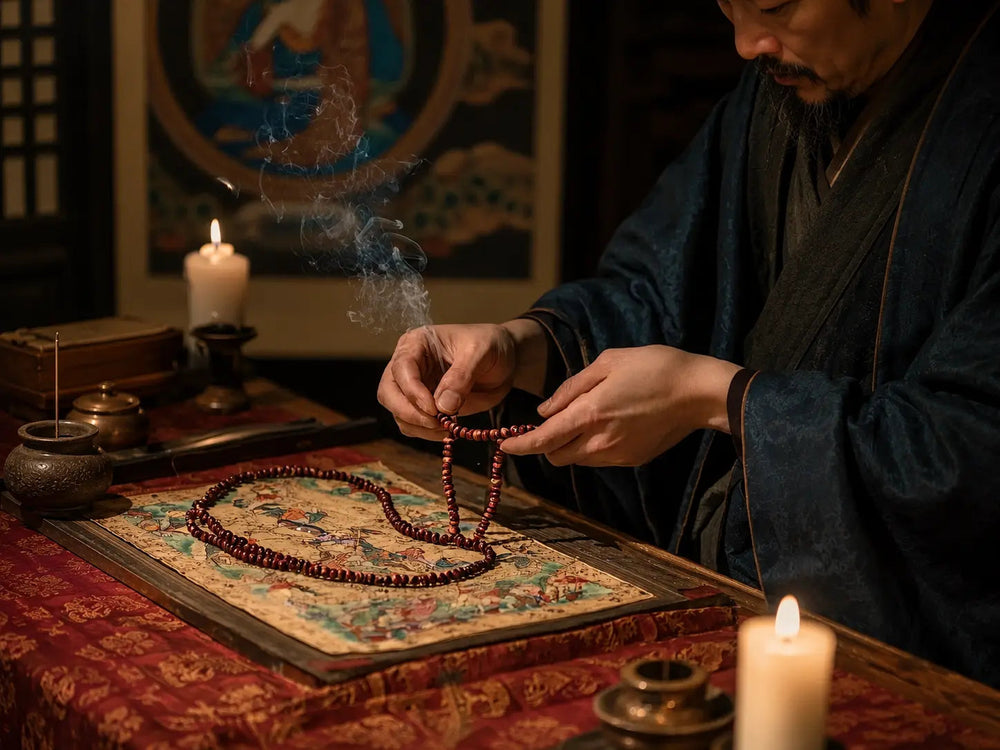
A 108-bead mala is a strand of counting beads used to support breath, mantra, intention, and repeated attention. Most full malas have 108 main beads plus one larger marker bead that shows where a round begins and ends. The meaning is both cultural and practical: each bead gives the hand one place to return, one breath or phrase at a time.
That is why 108 mala beads are not just a necklace with many beads. They are a structure for repetition. The hand moves, the breath slows, the mind returns, and the same intention becomes easier to notice. For modern wearers, a mala can also be worn as mindful jewelry, but its deeper value comes from how often it brings attention back to what matters.
This guide explains 108 mala beads meaning, how to use mala beads as a beginner, why the number 108 matters, what the marker bead means, and how to choose between a mala necklace, bracelet, bodhi beads, sandalwood, lapis lazuli, and other materials by intention.
What Are 108 Mala Beads?
108 mala beads are a full strand of beads traditionally used for counted repetition. The repetition may be a mantra, a breath, a short phrase, a moment of attention, or a personal intention. A full mala normally has 108 counting beads and one larger marker bead. Some malas also include divider beads, knots, tassels, or pendants, depending on the style.
The simplest definition is this: a mala helps the body count so the mind can return. Instead of tracking numbers in your head, your fingers move from bead to bead. This makes the practice physical. The hand has something to do, and the mind has one less reason to drift.
That tactile quality is the reason mala beads still matter. A phone app can count. A timer can count. A screen can count. But a bead strand changes the experience because the count happens through touch. The repetition is not only measured; it is felt.
Healthline describes mala beads as a type of prayer bead that can also be used today as a mindfulness aid, noting that traditional malas often include 108 beads plus a larger guru bead. TheFuMaster uses a more neutral phrase in customer-facing guidance: marker bead. The function is the same in this article. It marks the beginning and ending point of a full round.
Why Do Mala Beads Have 108 Beads?
The number 108 has many explanations across Eastern traditions, yogic systems, and meditation lineages. No single explanation should be treated as the only truth. That is important because a reader can respect the number without turning it into pressure.
Some explanations connect 108 with wholeness. Some connect it with the many states, habits, or obstacles that the mind moves through. Some connect it with traditional counting systems. Some simply treat 108 as a complete round: enough repetitions to feel meaningful, but still finite enough to finish.
The practical meaning may be the most useful for a modern wearer. A full 108-bead mala gives you a round. You begin, you move bead by bead, and eventually you return to the marker bead. That beginning, middle, and ending structure gives attention a path. It turns an abstract intention into something the body can complete.
This is why 108 matters even if you do not memorize every traditional explanation. The number gives your practice shape. It says: do not rush one repetition and call it done. Also do not make the practice endless and vague. Walk the full strand. Let belief have a rhythm.
The Practical Meaning of 108
For daily life, 108 can be understood as a complete cycle of return. Each bead is small, but the full round is not small. That combination is useful. It makes attention manageable without making it shallow.
If you are using the mala for breath, 108 beads can become 108 full breaths. If you are using it for a phrase, 108 beads can become 108 repetitions of the same sentence. If you are using it for intention, 108 beads can become a repeated return to one direction. The number is not there to intimidate you. It is there to help the practice become whole.
People often overcomplicate this. They ask whether the number is powerful by itself. A better question is whether the number helps you repeat with attention. One bead can remind you. A full round can train you. Repetition is where the meaning becomes lived.
This is also where 108 mala beads connect with manifestation in a grounded way. Manifestation is not asking the beads to create a result for you. It is attention, belief, and repeated action moving in the same direction. A mala helps because it shows you what you are repeating. The beads do not do the work. They help you return to the work.
What Is the Marker Bead?
The marker bead is the larger bead, focal bead, or ending bead that marks the start and finish of a mala round. Some people call it a guru bead. In this article, marker bead is the clearer customer-facing term because it describes the function without making the piece sound like a religious requirement.
The marker bead is not usually counted as one of the 108 main beads. It works more like a doorway or turning point. You begin next to it, move around the strand, and return to it when the round is complete.
Many traditional instructions suggest pausing at the marker bead instead of crossing over it. If you want to continue, you turn the mala around and move in the opposite direction. The practical value of this habit is simple: it keeps the practice from becoming automatic. The marker bead asks you to notice that one round has ended.
That pause matters. Without a pause, repetition can become mechanical. With a pause, the mala teaches rhythm: begin, continue, return, notice, decide whether to begin again.
How to Use Mala Beads for Breath
The simplest beginner method is breath counting. You do not need a long phrase, special background, or perfect setting. You only need the mala, your hand, and enough quiet to feel one breath at a time.
- Hold the mala lightly in one hand.
- Find the marker bead and start with the bead next to it.
- Take one full inhale and exhale.
- Move to the next bead.
- Repeat one full breath per bead.
- When your mind wanders, return to the next bead without judging yourself.
- Stop when you return to the marker bead.
This method is useful because it keeps the practice honest. You cannot pretend you are focused for a long time. You notice each bead. You notice each breath. You notice when you drift. The mala does not punish distraction. It gives you a place to come back.
For a shorter version, move through only 27 beads or 54 beads if your mala has divider points. A full 108-bead round is valuable, but a short attentive round is better than a long rushed one.
How to Use Mala Beads With an Intention
You can also use mala beads with a simple intention. This is especially useful for people who want the mala to connect with daily life rather than only seated practice. The intention should be short, plain, and repeatable.
Good beginner examples include: "I return to calm." "I move with clarity." "I choose one steady step." "I come back to what matters." "I keep my attention where my life is growing." These are not magic sentences. They are directions for attention.
To practice, begin next to the marker bead. Touch one bead, repeat the intention silently or softly, and move to the next bead. If the phrase begins to feel empty, slow down. The goal is not speed. The goal is to give belief a rhythm.
This is the grounded version of manifestation. A mala does not manifest for you. It helps you notice what you are repeating. If the same intention returns through the hand, the breath, and daily behavior, belief becomes easier to practice. The object reminds you. Your choices give the reminder weight.
Can You Wear Mala Beads Without Formal Practice?
Yes. Many people wear mala beads as a necklace or wrapped bracelet without doing a formal seated practice every day. That can still be meaningful if the mala has a clear role. The question is not whether you are performing a perfect method. The question is whether the beads help you return to something you have chosen.
If you wear mala beads only as decoration, that is a style choice. If you wear them as a tactile reminder, they become more personal. The difference is attention. When you see the beads, touch them, adjust them, or feel their weight, you can use that moment as a small return.
This matters for busy people. Not everyone has a quiet hour. Some people need a reminder during work, travel, parenting, study, or business pressure. A mala necklace can sit near the chest as a private reminder. A wrapped wrist mala can appear while the hands are active. Both can support the same idea: return before you react.
Wearing mala beads without formal practice should still be done with respect. Respect does not mean fear. It means not treating the piece as a disposable trend or a guaranteed outcome. Choose it because the form helps you remember who you are trying to become.
Do Mala Beads Have to Be 108?
No. A full mala often has 108 beads, but other counts exist and can be useful. The best count depends on how you plan to use the piece.
A 108-bead mala is the complete format. It is best when you want a full round, a necklace-length strand, or a deeper commitment to repetition. It can also be wrapped around the wrist, depending on bead size and strand length.
A 54-bead mala is a half round. It works well when a full 108 feels too long but you still want structure. A 27-bead mala is a quarter round and is easier to carry or use for shorter pauses. An 18-bead wrist mala is more of a daily reminder than a full counting strand, though it can still support repeated attention.
Just-Buddha's guide makes this practical distinction clearly: 27 beads can work as a quarter round, 54 as a half mala, and 18-bead wrist malas are common for all-day wear. That is the kind of distinction buyers actually need. The question is not only "Which count is traditional?" The better question is "Which count will I use?"
108 Mala Necklace vs Mala Bracelet
A 108 mala necklace and a mala bracelet can carry similar meaning, but they show up differently in daily life. The form changes the reminder.
A necklace mala is closer to the full traditional structure. It has more room for the complete 108 count, rests near the chest, and can feel more private. It is fitting for someone who wants a full round, a longer strand, or a piece that can be worn close to the body while still being available for touch.
A bracelet mala is easier to notice during action. Because it sits on the wrist, you may see it while typing, writing, opening a door, paying, holding a cup, or reaching for your phone. That makes it useful for daily return. It interrupts autopilot.
If your main goal is a full repeated round, choose a 108 mala necklace or a full mala that can wrap around the wrist. If your main goal is quick daily awareness, a wrist mala or shorter bead strand may be more practical. If you want both, choose a full 108 mala that feels comfortable enough to wear and easy enough to handle.
How to Choose Mala Beads by Material
Material changes how a mala feels in the hand and on the body. It is not only about color. Touch, weight, warmth, texture, and sound all affect whether you will actually use the beads.
Bodhi beads are a good choice when you want simplicity, return, and a practice-oriented feeling. They feel connected with steadiness because the surface is tactile and the visual tone is often quiet. The White Bodhi 108 Mala is a strong example for someone who wants a full 108 structure with a calm, pale look.

Sandalwood is a good choice when you want warmth and a grounded hand feel. Wood beads can feel lighter and more organic than stone. The Warm Earth Red Sandalwood 108-Bead Mala fits readers who want a warmer bead rhythm for breath, touch, and everyday texture.
Lapis lazuli is a good choice when your intention is clarity, focus, and thoughtful expression. Its deep blue color gives the mala a more defined visual presence. The Lapis Lazuli 108 Mala Necklace is suitable for someone who wants the full 108-bead format with a cooler, more focused tone.
Whatever material you choose, do not start with the most dramatic claim. Start with touch. Does it feel good in your hand? Is the weight comfortable? Do you want to wear it often? Does the material match the intention you want to repeat? A bead strand that you actually use is stronger than a more expensive one that stays in a drawer.
How TheFuMaster Frames Mala Meaning
TheFuMaster treats mala beads as wearable practice and symbolic jewelry, not as a shortcut to a promised result. The bead count matters. The material matters. The intention matters. But the deeper value comes from repetition.
This is why mala beads fit the brand's larger idea of belief made practical. Belief becomes stronger when it has a rhythm. A 108-bead mala gives that belief a physical path: one bead, one breath, one return. You are not asking the object to do life for you. You are giving your attention a form it can come back to.
If you are choosing your first mala, begin with the broader Mala Beads collection. Look at the count, material, size, weight, and how you expect to wear it. Then choose the piece that fits your real daily rhythm.
For a clean and quiet full strand, start with White Bodhi. For warmth and tactile grounding, look at red sandalwood. For clarity and a deeper blue tone, consider lapis lazuli. The right choice is not the one with the most dramatic story. It is the one that will keep bringing you back.
Common Mistakes When Choosing 108 Mala Beads
The first mistake is treating 108 as a rule you must fear. A full 108-bead mala is meaningful, but shorter counts can still be useful. Choose based on use, not anxiety.
The second mistake is buying by material claim instead of touch. A bead can have a beautiful story, but if it feels too heavy, too sharp, too slippery, or too distracting, you may not use it. The hand matters.
The third mistake is expecting the mala to create a result automatically. A mala can support attention, but it does not replace behavior. If your intention is clarity, you still need clearer choices. If your intention is patience, you still need patient actions.
The fourth mistake is putting too many intentions into one strand. Do not ask one mala to carry calm, luck, focus, confidence, love, money, discipline, and transformation all at once. Choose one main direction. Repetition works better when the message is clear.
The fifth mistake is never using the mala after buying it. Meaning grows through contact. Wear it, hold it, count a few breaths, return to one phrase, or let it interrupt your rush. A mala becomes meaningful through repeated return.
Final Guidance
108 mala beads are meaningful because they make attention repeatable. They take an intention that could stay abstract and give it a path through the hand. One bead is small. A full round is steady. That is the lesson.
If you are drawn to mala beads, respect that attraction. It may mean you are looking for a slower rhythm, a clearer anchor, or a way to make belief less vague. You do not need to overcomplicate the practice. Begin with one breath, one bead, one phrase, or one daily moment of return.
The beads do not promise the outcome. They help you remember the direction. When the same direction returns through touch, breath, belief, and action, the mala becomes more than something you wear. It becomes a quiet structure for becoming more consistent with yourself.
FAQ
What are 108 mala beads?
108 mala beads are a full strand of counting beads used to support breath, mantra, intention, or repeated attention. Most full malas include 108 main beads plus a larger marker bead that shows where a round begins and ends.
Why do mala beads have 108 beads?
108 has several traditional explanations, but the practical meaning is that it creates a complete round. It gives repetition a beginning, middle, and ending, so attention can move through a full cycle.
Do mala beads have to be 108?
No. Full malas often have 108 beads, but 54, 27, and 18 bead formats can also be useful. The right count depends on whether you want a full round, a shorter practice, or a simple daily reminder.
What is the marker bead on a mala?
The marker bead is the larger bead that marks the start and finish of the round. It is not usually counted as one of the 108 main beads. When you reach it, pause before deciding whether to continue.
Should I cross the marker bead?
Many traditional instructions suggest not crossing over the marker bead. Instead, pause and turn the mala around if you want another round. This keeps the practice from becoming mechanical.
How do beginners use mala beads?
Begin next to the marker bead. Take one full breath or repeat one short intention per bead. Move slowly to the next bead. When your attention wanders, return to the bead in your hand and continue.
Can I wear mala beads without formal practice?
Yes. Mala beads can be worn as a necklace or bracelet without a formal practice, but they become more meaningful when they remind you to pause, breathe, or return to a chosen intention.
What is the difference between a mala necklace and mala bracelet?
A mala necklace is better for a full 108-bead structure and a more private body-worn reminder. A mala bracelet is easier to notice during daily action because it sits on the wrist.
Which mala material should I choose?
Choose bodhi beads for simplicity and return, sandalwood for warmth and tactile calm, and lapis lazuli for clarity and focus. The best material is the one that feels good in your hand and fits your daily use.
Are mala beads only for formal traditions?
No. Mala beads have roots in several traditions, but modern wearers may also use them as symbolic counting beads or mindful jewelry. They are not a requirement. Their value comes from attention and repeated return.
Can mala beads support manifestation?
Yes, if manifestation is understood as attention, belief, and repeated action. A mala does not create the result by itself. It helps you repeat the intention and notice whether your daily choices are moving with it.
What should I do if my mala breaks?
A broken mala usually means the string or material has worn down. It does not need to be treated as a bad sign. Restring it, repair it, or choose a new strand, then return to the intention with care.